Lesser-known sales tax faces pivotal 2026 vote, opportunity to define its next chapter
December 18, 2025 | Haines Eason, Freelance Kansas
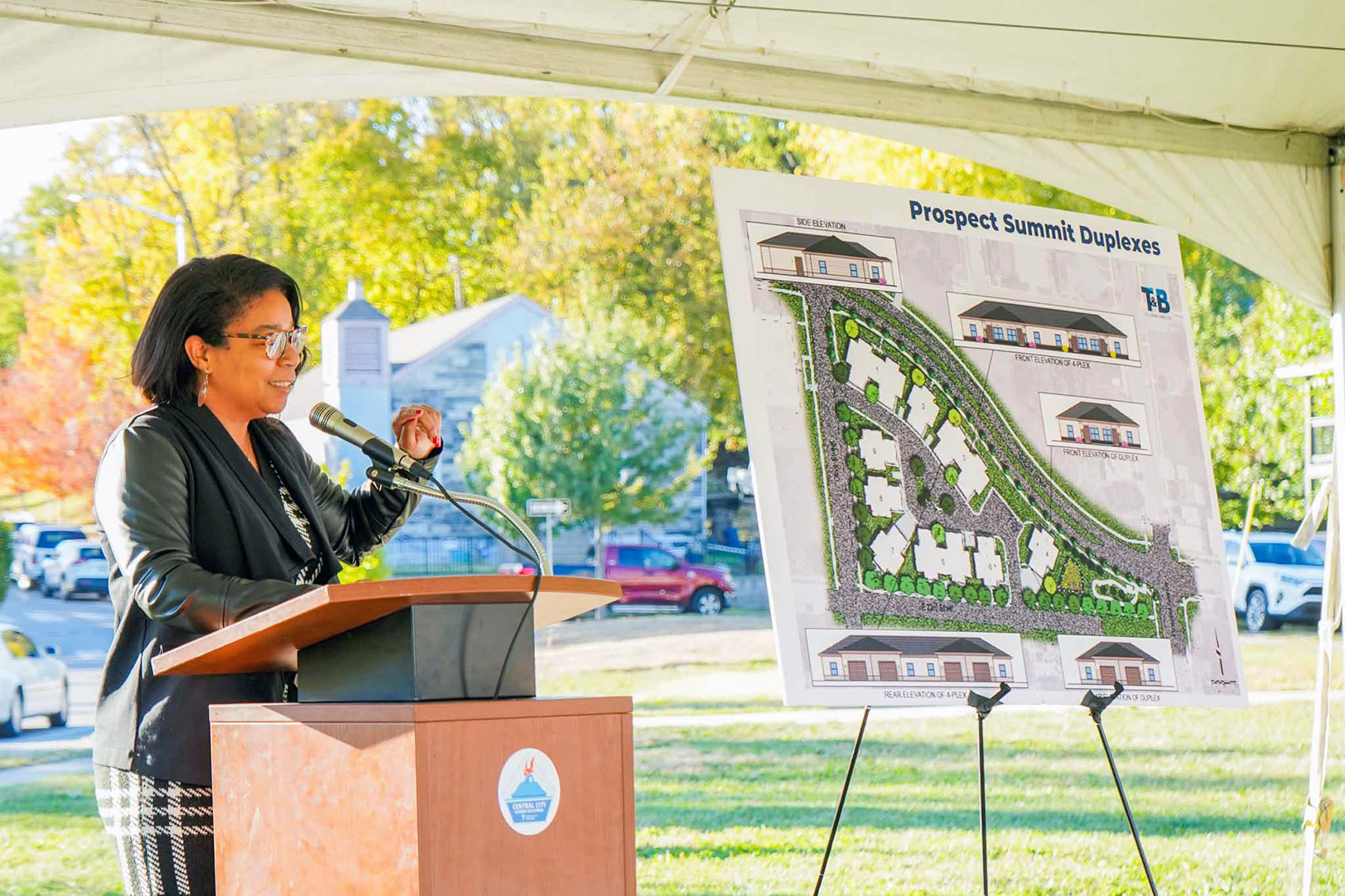
KCMO Councilwoman Melissa Patterson Hazley speaks in November at a groundbreaking event for the Prospect Summit Duplexes, a project supported by the Central City Economic Development (CCED) Sales Tax Program; photo by Brian Escobar, EDCKC
Editor’s note: The following details the Kansas City’s Central City Economic Development (CCED) sales tax initiative within the Economic Development Corporation of Kansas City. EDCKC is a paid partner of Startland News.
A decade-long experiment in east side investment is entering a new crucible as Kansas City’s CCED sales tax district heads toward a quiet but consequential moment: a 2026 renewal vote that will determine whether one of the city’s most unusual and community-driven tax tools gets a second life.
Born from decades of underinvestment, redlined lending patterns and a stubborn appraisal gap that pushed private development elsewhere, the one-eighth-cent Kansas City’s Central City Economic Development (CCED) sales tax has attempted something blunt and simple: provide the last-in dollars needed to make east-side projects real.
Some projects have been catalytic. Some have taken longer to complete than desired. All of them test whether Kansas City, Missouri, can correct market failures through sustained, intentional public investment.
Councilwoman Melissa Patterson Hazley, who once managed the CCED ballot campaign before joining KCMO’s city council, said the district exists because “the community took matters into their own hands after decades and decades of financial neglect.”
That neglect still shapes the landscape. But the path forward — and the pitch to voters in 2026 — now depends on whether CCED can evolve from a lean, sometimes improvised structure into a more predictable, more transparent, more disciplined version of itself.
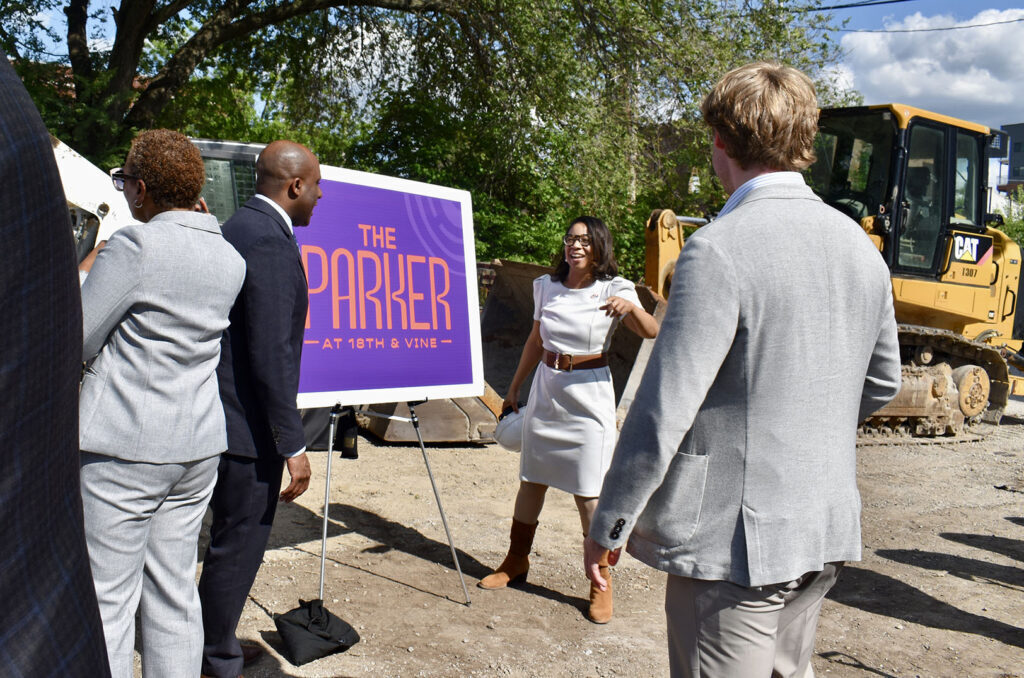
Kansas City Mayor Quinton Lucas laughs with Councilwoman Melissa Patterson Hazley during a groundbreaking event for The Parker in Kansas City’s historic 18th & Vine Jazz District, a project funded partly by the CCED sales tax; photo by Nikki Overfelt Chifalu, Startland News
A tax district built to counter a fundamental market failure
The CCED idea originated more than a decade before its 2017 approval.
Former Councilman Charles Hazley and a small circle of east side civic leaders spent years diagnosing what urban planners already knew but political leadership was slow to acknowledge: development on the east side costs the same as anywhere else — but it almost never appraises the same.
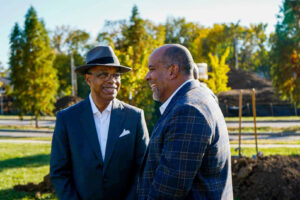
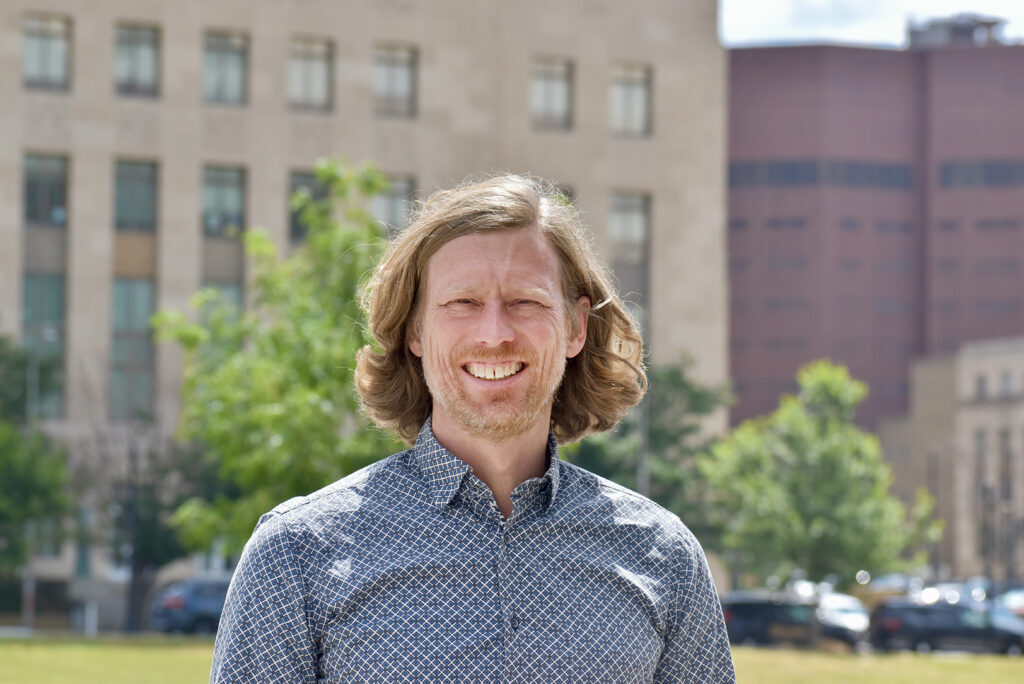
Ken Bacchus, CCED board member, and Matt Fulson, Fulson Housing Group, share a laugh during a November groundbreaking event for the Prospect Summit Duplexes, a project supported by the Central City Economic Development (CCED) Sales Tax Program; photo by Brian Escobar, EDCKC
Kenneth Bacchus, who was appointed to the CCED board in 2019 but was involved even earlier with its conceptual phase, explained the math that too-often doomed private development:
“You could build a building to cost $100,000 on the east side … and you can build the same building on the west side. The problem (comes) when you go to closing … the banker says, ‘There’s no way in hell I’m going to underwrite a $100,000 house that’s only worth seventy.’”
A 30 percent valuation gap made the entire geography functionally unfinanceable.
That’s the market failure CCED was designed to correct.
After years of neighborhood meetings, a citywide education campaign; support from State House Reps. DaRon McGee Randy Dunn and State Sen. Barbara Washington; and a late push from then-councilmember Quinton Lucas, voters approved the measure in 2017.
The district stretches roughly from Ninth Street to Gregory, between Indiana and Paseo — a corridor shaped by highway disruptions, decades of blight, environmental burdens and disinvestment well documented in city planning archives and regional housing studies.
What the CCED promised wasn’t flashy: help projects pencil out. Fill the last capital gap. Signal to banks, lenders and developers that the city was willing to share the risk that the market refused.
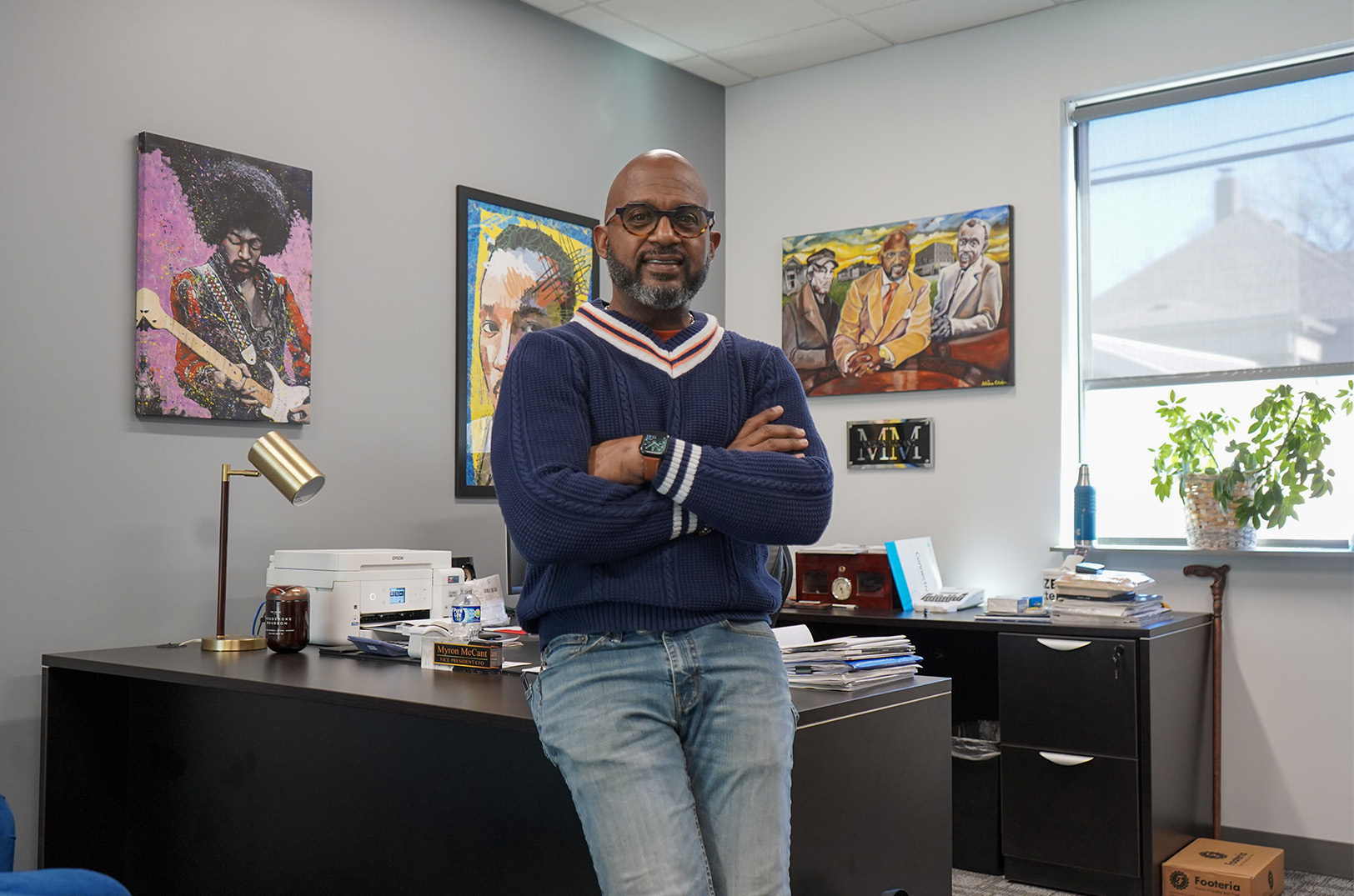
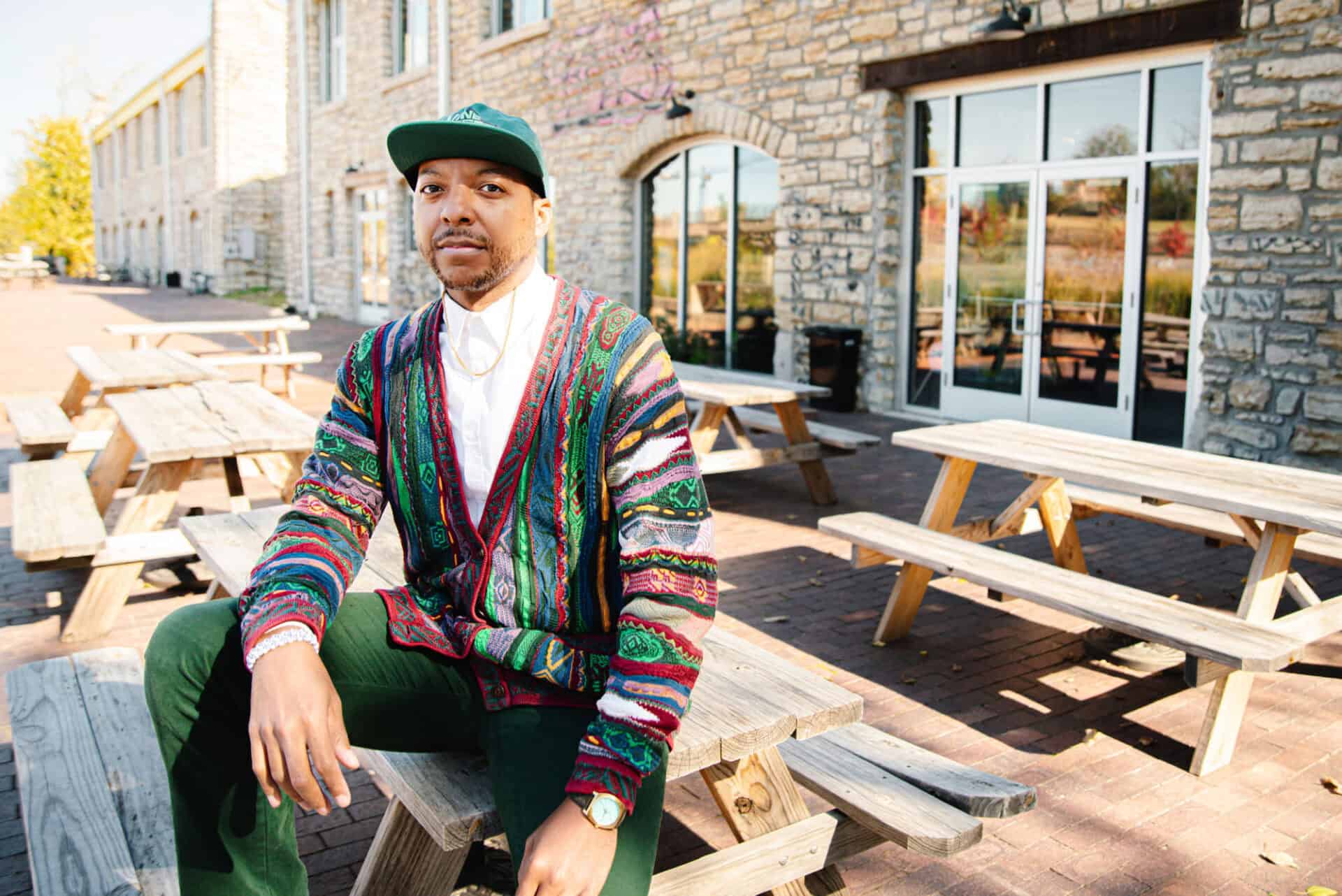
Myron McCant, KD Academy; photo by Brian Escobar, EDCKC
What’s actually been built — and why it matters
Six years in, CCED has produced a mix of childcare centers, housing, commercial builds and historic rehabilitations. Some are small. Some are long overdue. Some — even the modest ones — have outsized impact.
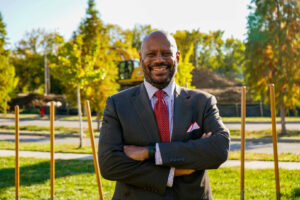
Dan Cranshaw, board chair for the CCED sales tax district, at a November groundbreaking event for the Prospect Summit Duplexes, a project supported by the Central City Economic Development (CCED) Sales Tax Program; photo by Brian Escobar, EDCKC
The clearest examples show how economic stability begins with the ability to work — something impossible without childcare, said Dan Cranshaw, board chair of the CCED sales tax district, pointing specifically to KD Academy, a 24-hour childcare center supported by CCED funding.
“It has got a profound economic ripple effect,” he said. “It allows a family to work and take care of themselves. It allows them to make money. It allows them to make their investment in the economy … KD Academy has been able to transform and change the trajectory of an entire family’s life.”
Emmanuel Family & Child Development Center on Prospect tells a similar story: anchor-like childcare investments that let parents work non-traditional hours, stabilize household finances and — critically — give lenders more confidence about the surrounding environment.
Other visible wins include:
- The Prospect Summit Duplexes, which received gap funding from CCED. A 100-percent affordable housing development, the project will deliver 24 new townhomes at 22nd and 23rd Streets along Prospect Avenue.
- The Vine Street housing surge, including new multifamily units and rehab of historic structures.
- The Overlook project and surrounding infrastructure upgrades — costly, slow, but finally moving.
- Gentler, quieter work: plumbing, electrical and safety updates for aging homes in historic districts where seniors want to stay but face outdated wiring, failing systems and gentrification pressure.
CCED leaders consistently emphasize that each of these wins pulls additional investment. That matches national research: Targeted public gap financing in historically disinvested neighborhoods tends to generate a multiplier effect of private activity so long as early projects land successfully.
Kansas City is not unique there — but the east side’s valuation deficit has made every early win matter more.
The 2.0 moment — professionalization and pressure
If CCED’s first phase was proof of concept, the next is about proof of capability.
For years, CCED relied on staff who handled the district as part of larger job portfolios — a patchwork that worked just well enough, but struggled under the weight of a growing pipeline. Several rounds saw avoidable delays. Developers ran into slow city approvals. Smaller minority-led builders lacked technical assistance. Community members couldn’t track progress unless they happened to live near a project site.
Patterson Hazley doesn’t sugarcoat the need for a structural upgrade:
“We need a structured, dedicated professional staff,” she said. “This is a generational opportunity. It warrants staff that are solely focused on the fund itself.”
Under a new arrangement, the Economic Development Corporation of Kansas City (EDCKC) now houses a dedicated CCED-focused team: a shift intended to deliver predictable funding rounds, clearer communication, stronger developer guidance and the kind of internal tracking needed for voter-facing transparency.
Cranshaw stressed that transparency is non-negotiable.
“We have hard conversations right there on the camera,” he said. “So folks see what’s happening, how we are spending their money and how we’re thinking about it.”
This is the core of the CCED “2.0” argument: a district that is no longer improvising, but operating like a stable, mature economic development tool.
There are early signs of change: a growing share of recent-round projects are already under contract and groundbreakings are happening more frequently compared to earlier rounds.
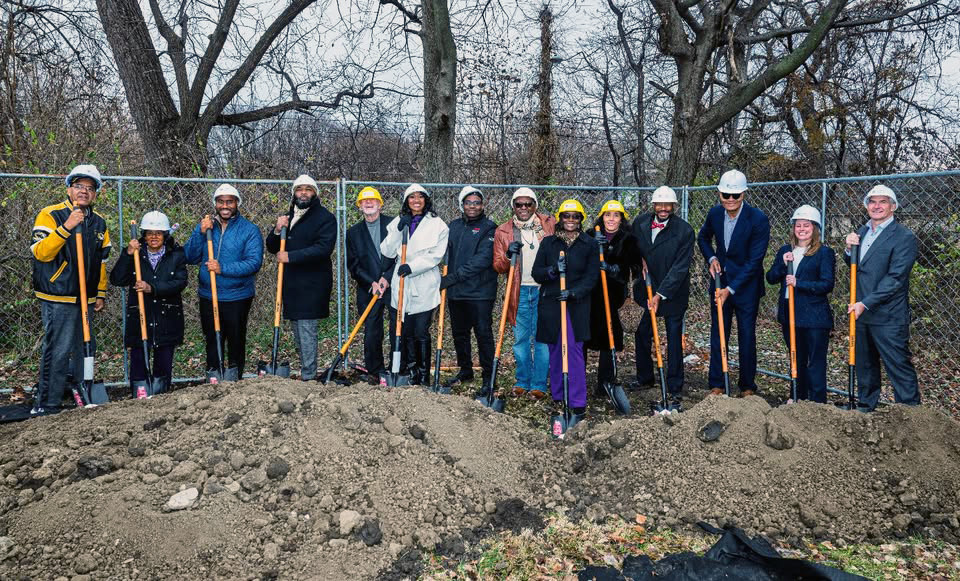
A December groundbreaking event for the Essential Families Office Building and Francine Marie Kerr Family Center, a major community investment at 2409 Prospect Avenue supported by the Central City Economic Development (CCED) Sales Tax Program and Paramount Bank. This new facility — representing a $2.64 million investment, including $916,093 from CCED — will serve as the permanent home for Essential Families’ digital equity, economic mobility, and family-support programs—expanding access to digital tools, workforce pathways, financial literacy resources, and 24/7 wraparound services for households across Kansas City’s East Side; photo courtesy of EDCKC
The friction points that still matter — and will matter in 2026
Even with stronger structure, CCED faces barriers that no tax renewal can magically wash away:
- City permitting and approvals can still be sluggish. Some round-one projects continue to navigate conflicts and legacy workflows.
- Environmental remediation slows construction. As Cranshaw noted, digging into soil on the east side continues to surface the legacy of industrial dumping and discriminatory land use.
- Too few pipelines putting east-side youth into construction, architecture, engineering and development careers.
- Minority-owned contracting businesses can face a sizable bonding hurdle. While the city is home to sizable minority-owned subcontractors with capacity to take on big projects, the large bonds big projects require, often exceeding $30 million, mean minority-owned contracting firms may need to partner or form joint ventures to secure big deals.
- Most voters never physically encounter a CCED project. Distance and invisibility remain political vulnerabilities.
Patterson Hazley argued that solving the workforce challenge is essential to solving the credibility challenge. She points to KC Future Builders — a pipeline she helped launch through KCPS — which takes students on active construction sites, connects them with trades, and works to place them directly into jobs, not just apprenticeships.
“We want companies to hire people that live in the community,” she said. “That’s how you impact violent crime … That’s how you impact home ownership and stability and education.”
The implication is obvious: If CCED wants voters to see the value, it must show them visible projects and visible economic mobility.
Editor’s note: City leadership currently is discussing an August 2026 renewal vote for the Central City Economic Development Sales Tax District, but an officially confirmed ballot date has not yet been set.
What 2026 really tests
If renewal were only about popularity, CCED would have a more difficult road: The tax is small, the projects are spread out, and development work is slow — sometimes painfully so.

But renewal is less a referendum on marketing than belief. Specifically: does Kansas City believe that targeted, deeply local investment in historically excluded neighborhoods generates measurable, citywide good?
Cranshaw tried to distill the mission down to one line:
“We empower partners on the east side to make transformative generational change in their communities.”
That’s the heart of the upcoming vote. Not a promise of miracles. Not an argument that every project has been perfect. Not a gloss over the slow starts, the staff limitations or the structural barriers that remain.
Rather, a recognition that generational neglect isn’t solved by market forces alone — and that the district now has enough momentum, enough visible proof and soon enough professional stability to justify a second decade.
The next chapter will hinge on execution: clearer communication, cleaner data, tighter processes, more visible wins and the kind of workforce outcomes that make the economic mobility argument undeniable.
Haines Eason is the owner of startup content marketing agency Freelance Kansas. Previously he worked as a managing editor for a corporate content marketing team and as a communications professional at KU. His work has appeared in publications like The Guardian, Eater and KANSAS! Magazine among others. Learn about him and Freelance Kansas on LinkedIn.
Fund More Stories
This story was made possible by readers like you. Join them — make a one-time contribution or become a monthly member to sustain our work.